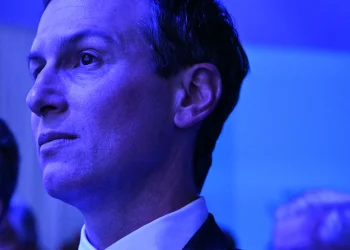





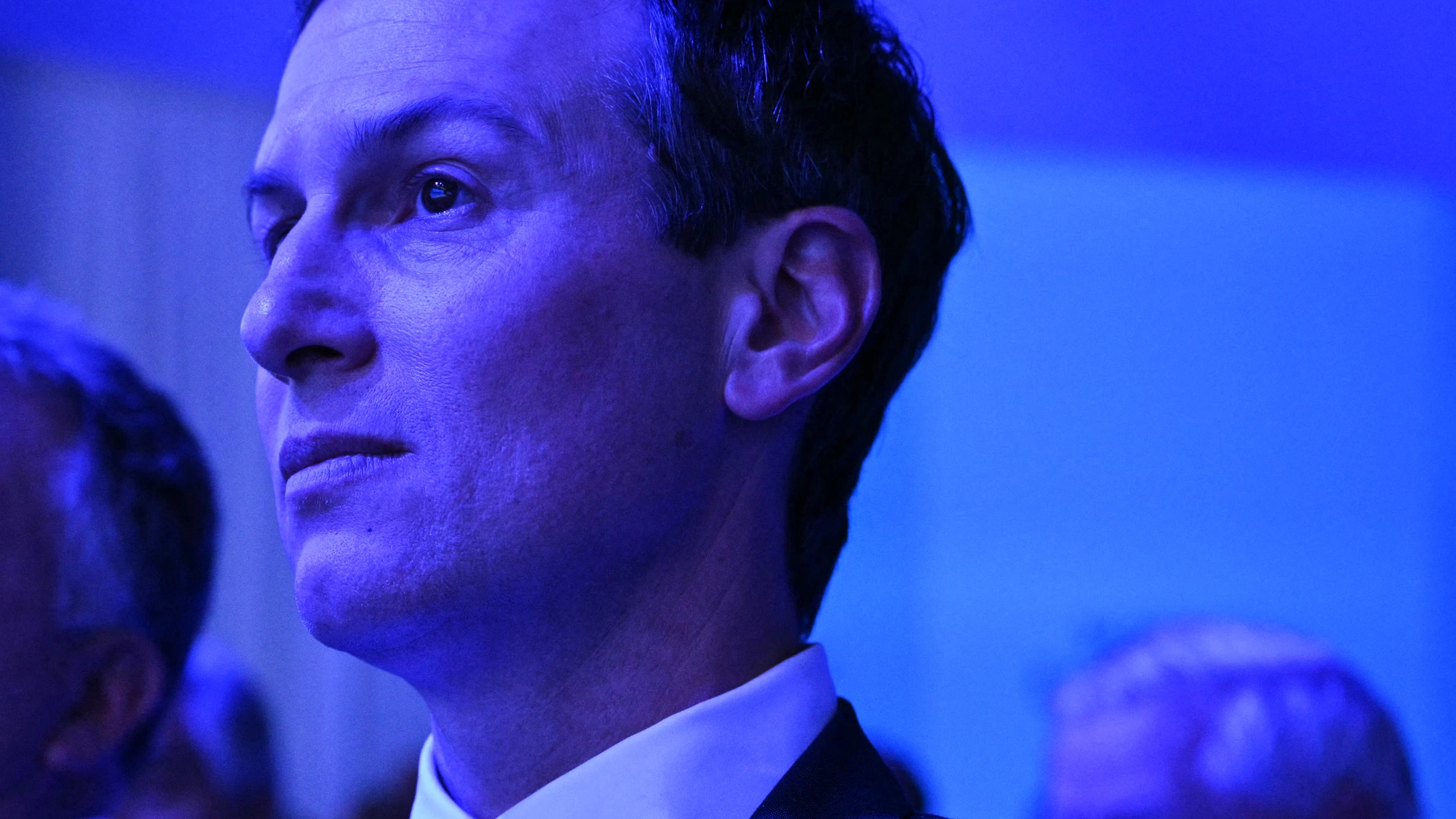
SEC filings reveal that the president’s son-in-law is negotiating for peace while profiting from war.
By Ariel Sabar
Jared Kushner was incensed. On October 1, CNN had published an investigative report suggesting that he was profiting from the war in Gaza even as he was serving as a U.S. mediator working to resolve the conflict. Kushner’s private-equity firm, Affinity Partners, was the largest shareholder in an Israeli company called Phoenix Financial, which CNN journalists found had stakes totaling hundreds of millions of dollars in nine Israeli defense contractors. All nine companies saw their stock values rise last year, according to the news network, and many of them credited the Gaza war with boosting demand for their products.
In a set of lengthy internet posts, Kushner assailed the CNN report—and the conflicts of interest it accused him of—as unfair. Affinity Partners had made its first, $129 million investment in Phoenix in July 2024, four months before President Trump was reelected and half a year before Kushner returned to public service, at Trump’s behest, as a volunteer peace envoy, trying to negotiate settlements in the Middle East and Ukraine. Kushner stressed that he had no control over Phoenix’s investment choices—he called Phoenix “the Israeli equivalent of Vanguard or Fidelity,” companies that manage many investments—and that neither he nor Affinity owned any of the defense contractors directly. “Misleading stories,” he said on X, “will not distract me from the work President Trump asked me to do: help end wars, bring people together and pursue peace.”
Unmentioned in any of Kushner’s posts, however, was that Affinity also owned a $32 million stake in a sprawling American defense contractor—a stake purchased after Trump’s reelection and Kushner’s return to public service but not disclosed until November 5, two days after the midterms, when Affinity belatedly updated a filing with the Securities and Exchange Commission. The filing, which has not been previously reported, revealed that Affinity had acquired 689,411 shares in a Connecticut-based company, called Arxis, that makes “mission-critical” components for F-35 fighter jets, Navy destroyers, nuclear submarines, and anti-missile systems, most of which have been deployed in the Middle East or Russia-Ukraine theaters in which Kushner has acted as a key negotiator.
From the January 2027 issue: How Jared Kushner sparked a revolution in the Balkans
Arxis comprises more than 30 aerospace and defense companies that were joined under a single umbrella and taken public this past April. In SEC filings this year, Arxis emphasized its dependence on the U.S. government for revenue, regulatory approvals, export controls, and security clearances. “The current administration is prioritizing investment in high-tech platforms including those already supported by Arxis (e.g., F-35 Joint Strike Fighter, DDG-51 destroyers, Virginia-class submarines and Next-Generation Overhead Persistent Infrared satellites),” Arxis said in the prospectus for its initial public offering.
Of the company’s $1.6 billion in revenue last year, some 47 percent came from defense and space spending. “We generate a significant portion of our revenue from suppliers and contractors for the U.S. government, particularly the Department of War,” Arxis said in its latest quarterly report. It also sells high-end components for military equipment directly to the U.S. government, and to foreign governments and their suppliers. The future, Arxis said in the prospectus, looked bright: “Ongoing global conflicts, coupled with the potential for future conflicts, have accelerated global defense investments.” U.S. military spending was projected to “reach $1 trillion by the fiscal year ended September 30, 2026, a substantial increase” over prior years that the company said was “driven by multi-theater conflicts and a more advanced and complex threat environment,” as well as “rising geopolitical tensions.” War, in short, had been good for business.
Arxis lost money in 2023 and 2024, according to its SEC filings, but turned profitable in 2025, the year Trump returned to office. Since going public in April, Arxis has seen its stock price rise by about 60 percent, peaking in early August before declining slightly. “In defense and space, we continue to benefit from our alignment to key government-spending priorities,” Kevin Perhamus, Arxis’s CEO, said in an earnings call this year. When a stock analyst asked for details, Perhamus said, “that’s air defense, radar, missile systems, missile-defense electronics, electronic warfare, modernization. You know, all of the priorities, the key government priorities that exist, we are broadly tied to and always have been.”
Under SEC rules, investment managers, such as Affinity, that own more than $100 million in certain kinds of public securities must disclose those holdings within 45 days of each quarter. But in mid-August, when Affinity filed its required paperwork, known as an SEC Form 13F, for the second quarter of 2026, the form made no mention of Arxis, even though Affinity had already acquired its shares in the company by then. The only shares it disclosed on the August form were $565 million worth of stock in a building-supplies company called QXO. Not until November 5—nearly three months after the August filing—did Affinity amend the form. The amendment declared the $32 million investment in Arxis as an omission from its second-quarter report, without explanation.
Neither Kushner nor the communications staff at Affinity Partners replied to repeated requests for comment by email, text, and phone today.
Kushner, Trump’s billionaire son-in-law, has been dogged for a decade by accusations of too freely mixing private and public business, first by failing to fully divest from his family’s real-estate empire and more recently as the owner of Affinity, which he founded in 2021. Kushner capitalized on relationships he built as a Middle East envoy during Trump’s first administration to raise as much as $6 billion for Affinity, the better part of it from sovereign-wealth funds in the same Gulf states he now deals with as a peace negotiator.
Read: Jared Kushner’s mysterious role in the Trump administration
Affinity has invested the funds it has raised in a variety of international businesses, including an online-classifieds company in the United Arab Emirates, a Brazilian fast-food chain, and the American video-game maker Electronic Arts. Arxis appears to be its first direct investment in the defense industry, a major departure from its other ventures, ripe with potential conflicts. As a commander in chief with little regard for bureaucracy or the will of Congress, Kushner’s father-in-law has broad power over military spending. Kushner, meanwhile, is mediating multiple global conflicts—Iran, Ukraine, Gaza—whose duration and outcomes bear directly on the defense industry.
Had Affinity disclosed its Arxis stake before the election—and had reporters picked up on it—it would have lent support to a spate of recent stories about Kushner’s alleged conflicts, including the CNN report, a New Yorker article from September, and a controversial book, published in late October, that claims that Kushner had access to secret bank accounts funded by the rulers of Saudi Arabia and the UAE. (He denies the book’s claim.) It would have also undercut his responses to the coverage, which included an uncharacteristically large number of social–media posts, denials, and counteraccusations from the usually reticent Kushner. His outpouring of indignation now seems to have taken place during a period in which he owned, but failed to disclose, a $32 million stake in an American defense company dependent on the government he served, and on the status of conflicts he was mediating, for a substantial portion of its revenues.
Was Kushner worried about how news of the investment might affect the midterms? It wouldn’t have been surprising. Democrats in Congress had named him among the top Trump-world figures they planned to investigate should they retake the majority.
As the wars in Ukraine and the Middle East have dragged on, Kushner’s interest in the defense industry appears to be growing. On November 12, a week after Affinity reported its stake in Arxis, another company announced Kushner’s firm as a new investor. The company, Q-Ctrl, sells a novel navigation technology sought by the U.S. military because it lacks the vulnerabilities of satellite-based systems such as GPS, which enemies can jam, spoof, or block—a problem endemic in recent conflicts. Last year, Q-Ctrl won a $24.4 million contract from DARPA, the Defense Department’s advanced-research arm, and a joint award, with Lockheed Martin, from the department’s Defense Innovation Unit. Among Q-Ctrl’s other investors is In-Q-Tel, a government-funded nonprofit created by the CIA to identify and develop new tech for intelligence and national security.
Before founding Affinity, Kushner had no substantive experience in private equity. One of the questions he’s faced is why nearly all of the money that Affinity has raised comes from Gulf royals with an existential stake in the results of his diplomacy. He now faces a new question: Why would a man working for peace be seeking to profit from war? || The Atlantic