




From 2,7 billion lek in 2023, funds for cleaning and waste management in Tirana reached 4,26 billion lek in 2026. At the same time, the city continues to face overflowing bins, waste on the sidewalks, and limited differentiation. Money and equipment have increased; the gap between spending and real service for citizens who pay the cleaning tax remains.
Ida Ismail
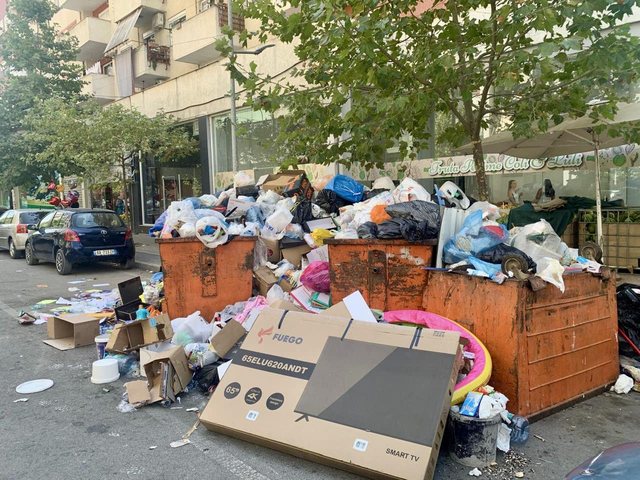
Billions of lek more, tenders for equipment and thousands of new bins, but the same reality on the streets of the capital: Overflowing bins, waste on the sidewalks and a strong smell. 10 years after the promise of a European model of waste management, Tirana still faces the question of where citizens’ money is going and why the increase in funds is not translating into a cleaner city?
“This is the situation we face every day. Overflowing trash cans that are next to sidewalks, blocking the road, and a strong odor that can turn into a risk for infections,” says a citizen in the Ali Demi area.
Cleaning the capital remains one of the biggest challenges for the Municipality of Tirana. Citizens pay a cleaning tax every month, while the service they receive does not seem to have improved at the same pace as the public funds allocated.
When the company Eco Tirana was founded in 2016, Mayor Erion Veliaj presented it as a modern European model for waste management. Veliaj declared at the time that Tirana would enter a new era of waste management, where source segregation would be one of the main pillars of the system. Citizens were promised waste separation in separate bins, increased recycling and reduced pollution.
But, a decade later, differentiation at source remains largely a paper objective.
In most of the city, waste continues to end up in the same collection system, while overflowing bins and waste outside them are still a common sight. Ironically, while the Municipality of Tirana has launched campaigns against individual waste collectors, often considering them part of the system’s problem, the very system of differentiation and recycling promised to citizens has not been implemented to the extent declared.
From March 2024, the company Eco Tirana sh.a. carries out the collection, transportation and disposal of urban waste throughout the territory of Tirana. According to the Municipality of Tirana, the service for the collection of recyclable waste is provided in 110 containers with a capacity of 3700 liters in the central area of Tirana, which are emptied twice a day.
But is this system sufficient for a city of the size and volume of waste that Tirana produces?
More money, but not more cleanliness
Budget figures show a significant increase in funds.
In 2023, the Municipality of Tirana planned around 2.7 billion lek for waste treatment and city cleaning.
In 2024, the fund grew to over 3.2 billion lek.
In 2025, 3.13 billion lek were planned.
While for 2026, the fund reaches 4.26 billion lek.
So, within a few years, the funds planned for waste management and city cleaning have increased by more than 1.5 billion lek. However, the budget increase does not seem to have been accompanied by an improvement in service.
Economic expert Ergis Sefa sees a problem in the way public funds are being used: “The financial expansion of around 55% for urban waste management from 2025 to 2026 seems like an anomaly in the medium-term budget programming cycle. In public economic terms, any additional allocation of funds is supposed to generate a positive margin of benefit for the taxpayer, but the reality on the ground seems to be the opposite. This raises the suspicion that we have an operational failure, where the marginal cost of cleaning does not translate into service quality. It clearly seems that we have an asymmetry between capital procurement on the one hand and operational efficiency on the ground, on the other.”
153 million lek for 3 thousand new toilets
In parallel with the increase in funds, Eco Tirana has developed numerous procurement procedures for tools, equipment and boilers. One of the most recent tenders, opened in July 2026, foresees the purchase of 3 thousand new boilers, with a limit value of 153 million lek.
For economic expert Sefa, purchasing new containers is a technically justified action only if it is accompanied by optimization of the logistics line: “Without a clear plan for collection routes, emptying frequency and maintenance, the investment risks remaining an irrecoverable cost. This causes public funds to be absorbed mainly by physical assets and not improve the final result: the most complete and effective sanitary cleaning of the city.”
The increase in funding was not only made through the initial budget. In May 2026, the Municipal Council approved an increase of about 818 million lek per year for waste management. The Municipality’s argument was to expand the service and increase the capacities of Eco Tirana.
The opposition has previously denounced the company Eco Tirana and demanded an investigation into its tenders, claiming that the company has not carried out waste differentiation in Tirana. According to MP Ina Zhupa, this company has held tenders worth billions of lek, most of which have had only one participant.
Environmental expert Olsi Nika estimates that waste is collected and deposited without a proper plan: “An integrated waste management strategy needs to be implemented, as collection is done at the expense of the environment, but also of the communities that live nearby.”
Tirana, the city that produces the most waste in Albania
Waste management issues also take on importance in the context of European integration. On August 28, 2025, during the opening of Chapter 27 “Environment”, Prime Minister Edi Rama described this chapter as one of the greatest challenges of negotiations with the European Union.
At the same time, the government presented a new waste management reform and a draft law aimed at aligning with European directives. The new philosophy places prevention, reuse and recycling at the center, while incineration remains the last resort.
But, here too, the main challenge is not just the adoption of laws and strategies, but their implementation on the ground. Local government expert Agron Haxhimali has raised concerns about the way the reform has been conceived and the role of the National Waste Management Agency.
“The role that AKEM has taken on, as a policymaker and decision-maker, does not go well with the principles of decentralization. We said that we would have 61 strong, policy-making municipalities close to the citizens. Now decision-making is moving to a very high vertical,” said Haxhimali.
With the creation of the National Waste Management Agency, 61 municipalities are required to report waste management data annually.
For 2024, AKEM has announced that there were some discrepancies in the reported data and that no data on the composition of waste was reported.
However, official data reported by municipalities show that Tirana is the municipality with the highest waste generation in the country.
In 2024, the capital generated 257.829 tons of waste.
In 2025, this figure reached 288.583 tons.
This means that Tirana alone produces nearly 30% of the entire country’s urban waste.
Precisely for this reason, source separation, recycling, and waste treatment are not simply environmental objectives, but concrete needs for a city that produces hundreds of thousands of tons of waste every year.
To ensure that the billions collected from cleaning fees are translated into real value for the capital, according to expert Ergis Sefa, public budgeting must undergo structural reforms.
“Contracts and payments should be linked to concrete performance indicators, including the time a bin stays full, periodic washing and disinfection. Cleaning finances require transparency on the real cost of collection, transport and disposal for each ton of waste, preventing overlapping billing or duplication of public costs. Real-time publication of vehicle routes via GPS and the creation of citizen audit systems with geographical location would eliminate the scope for operational failure or fictitious field service,” argues Sefa.
Tirana is facing a significant gap between what was promised, what was financed and what citizens see every day. Because in the end, the success of a waste management system is not measured by the number of tenders, the value of contracts or the number of bins purchased. But, it is measured by a much simpler indicator, how clean the streets where the citizens of Tirana live are. || acqj.al