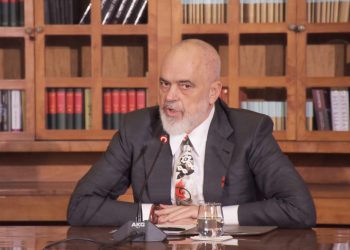






Amid a domestic legitimacy crisis—after the justice system indicted Deputy Prime Minister Belinda Balluku and brought charges over the creation of a structured criminal group at the helm of the National Agency for Information Society (AKSHI)—Prime Minister Edi Rama has turned his focus to an international diplomatic agenda, which experts say marks a further personalization of diplomacy.
By Blerina Gjoka / Reporter.al (BIRN)
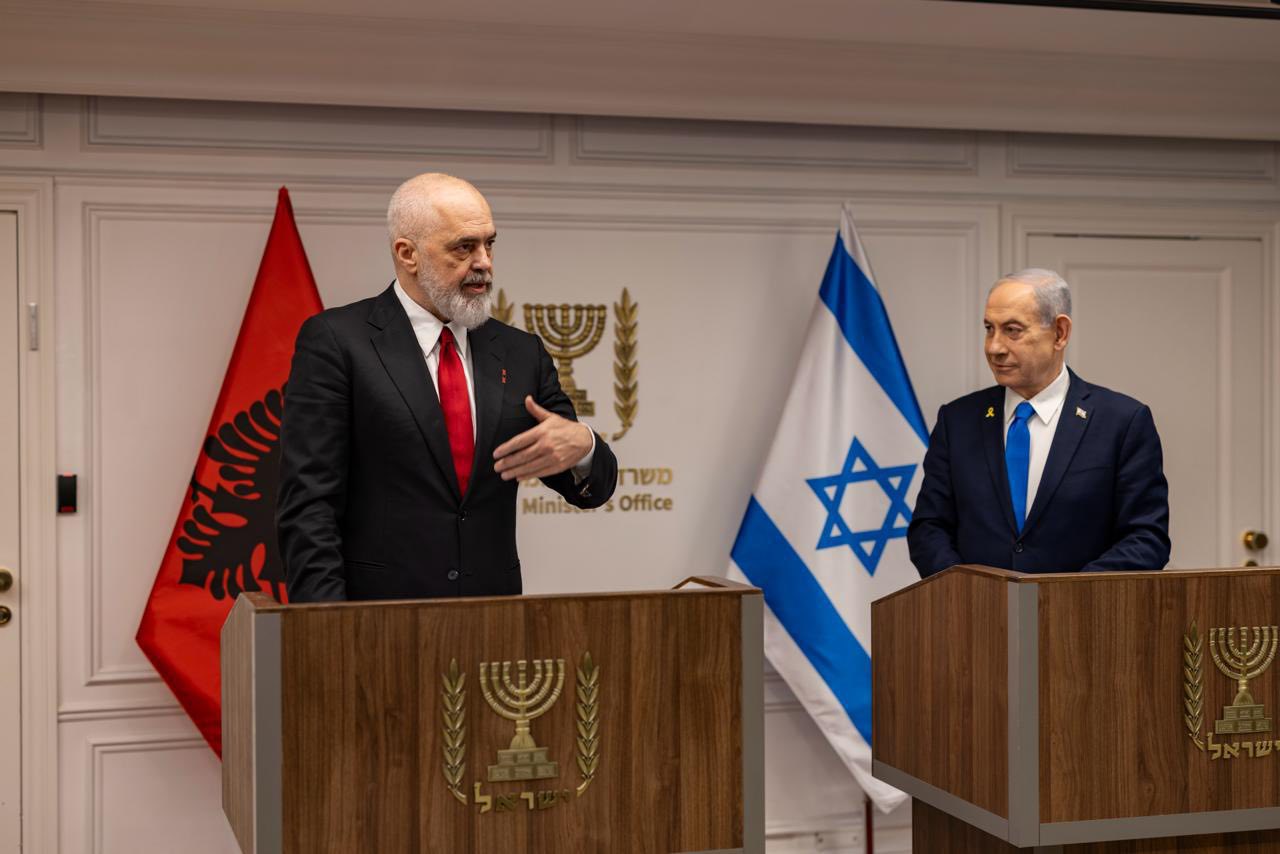
On January 26, Prime Minister Edi Rama was welcomed with applause at the Knesset, Israel’s parliament, where he held a two-day visit at the beginning of the week.
“I am still not entirely sure that I am truly standing here, on the very floor beneath my feet—the floor from which the most distinguished guests of this State have addressed this Chamber. And although modesty has never been my most steadfast virtue, I must say that I find it difficult to believe that I deserve such extraordinary recognition,” Rama said at the opening of his speech.
However, his seating alongside Israeli Prime Minister Benjamin Netanyahu—against whom the International Criminal Court issued an arrest warrant in November for crimes against humanity related to thousands of civilian victims in the Gaza Strip during the past year—was met with confusion and reservations in Tirana.
A citizens’ protest against Rama’s visit, under the slogan “Not in my name,” was dispersed by police on Friday in front of the Prime Minister’s Office, while the opposition largely responded with silence.
The only reaction came from Arlind Qori, leader of the “Together Movement,” who described the visit as evidence of a lack of dignity on the part of Albania—a country that has ratified the Rome Statute and recognizes the jurisdiction of the International Criminal Court.
“A state does not have only interests; it also has dignity and reputation in international relations. When you lose dignity and reputation, it then becomes easy to trample on national interests as well, as this government has done in recent years,” Qori told his followers on social media.
Rama’s visit to Israel also prompted mixed reactions among experts in International Relations, who view his international agenda as an attempt to personalize diplomacy at a time when he is facing serious problems at home.
“The state visit to Israel precisely at this moment reinforces the thesis of personal diplomacy at the expense of institutional and well-planned diplomacy,” says Ilir Kalemaj, a lecturer in International Relations.
According to Kalemaj, at a time when Prime Minister Netanyahu is facing international criminal charges for crimes against humanity and is also involved in domestic corruption proceedings in Israel, it would have been more appropriate for President Begaj to visit, or for Rama’s visit to be postponed to a later date.
“Instead, it appears that Mr. Rama not only accepted the invitation with pleasure, but is also trying to promote the reception with state protocol in the most propagandistic manner possible,” he added.
Arben Çejku, former ambassador and director of the Center for Good Governance, assesses Rama’s visit to Israel within the context of the ties between the two countries, viewing it above all as an expression of appreciation and gratitude for the role Albanians played during World War II in protecting Jews.
“Holding this visit on Holocaust Remembrance Day carried a particular meaning and dimension, because ultimately what our ancestors did decades ago—protecting Jews—is a story that makes us proud and deserves to be known worldwide. Such a story elevates our spiritual and humanitarian heritage,” Çejku said.
At the same time, he stresses that no step in diplomacy should be personal or undertaken without consultation.
“Against the backdrop of developments in Israel, Gaza, Europe and beyond, as well as in the context of other specific aspects of our regional relations, I believe there should be a more inclusive consultation with domestic stakeholders in Tirana, so that every step is thoroughly examined and, above all, so that we maintain a long-term stance in our foreign policy,” he emphasized.
Personal Diplomacy in Times of Crisis
At the start of the new parliamentary session, Albania’s Parliament approved under expedited procedures a draft law submitted by the Socialist parliamentary group, accepting Albania’s membership—represented by Prime Minister Edi Rama—in the Charter of the Peace Board, an initiative of U.S. President Donald Trump, accompanied by a model agreement text distributed by the White House to all invited states.
Although it voted in favor, the opposition contested the ratification procedure, which was carried out before the agreement had been signed, as well as the personalization of the membership by attaching Rama’s name to it.
According to Kalemaj, Albania’s state diplomacy has in fact been personalized by Rama throughout his entire period in office, a pattern also evident in the decision to join the Peace Board initiative.
“Naturally, the invitation is not personal, because states—not individuals—are represented. The attempt to maximize personalization by even including the prime minister’s name in the draft law is unheard of in the annals of diplomacy and legislation, and it appears aimed more at generating domestic political capital than at enhancing Albania’s role and weight on the international chessboard,” he says.
Kalemaj views this act as an attempt to divert attention from the corruption scandals facing the “Rama” government at home, such as the indictment of the government’s number two, Belinda Balluku, or the allegations of a structured criminal group at the top of the National Agency for Information Society (AKSHI).
During his 12 years in power, Rama has devoted considerable energy to diplomacy, seizing every opportunity to be present wherever an international event was taking place or to host European summits in Tirana—despite the limited real weight of a small country like Albania on the global stage.
For a period, Rama also assumed the role of Foreign Minister after former President Ilir Meta refused to decree his proposed nominee, and only days ago he publicly attacked the Ministry of Foreign Affairs for incompetence.
International relations experts see this behavior as an attempt to use diplomacy for personal credentials and to market this image domestically for political consumption.
“This has brought him international exposure, geopolitical marketing, and support that he has sold as domestic political capital, but Albania’s foreign policy and diplomacy have benefited very little,” Kalemaj said, adding that the prime minister’s personal brand has not translated into positive branding for the country.
For Arben Çejku as well, Albania’s foreign policy for many years has displayed tendencies of “prime-ministerial monopolization,” sidelining the role of the Ministry of Foreign Affairs, the Parliament’s Foreign Affairs Committee, and the President. This has also been facilitated by changes to the law on the “Foreign Service,” which indirectly oriented foreign policy toward the Prime Minister’s representative power.
“By using personal diplomacy, Rama has achieved some meaningful successes in his government’s foreign policy, especially in raising his own profile as a leader,” Çejku said, describing Rama as one of the rare cases of “enthusiastic engagement” by a prime minister in diplomacy.
At the same time, Çejku believes Albania’s membership in Trump’s Peace Board stems from Albanians’ traditionally pro-American stance. However, he predicts that Albania will play only a minimal role in this organization and that Rama will not derive significant personal benefit from it.
“As for personal and political benefits from participation in this Board, I believe that even if they exist, they will be temporary. At the end of the day, citizens need to be governed well, to have more justice, and to achieve the objective of EU membership,” he says.
Çejku also believes that Albania’s internal problems cannot be concealed by foreign policy and that the domestic focus will once again return to justice and its outcomes.
“Ultimately, regardless of foreign policy successes or what we described as ‘personal diplomacy’ and strong lobbying in key international centers such as Washington, Brussels, Israel, Turkey, and others, internal problems and developments related to our daily lives will be the most truthful answer to any promises we make abroad,” he concluded.