




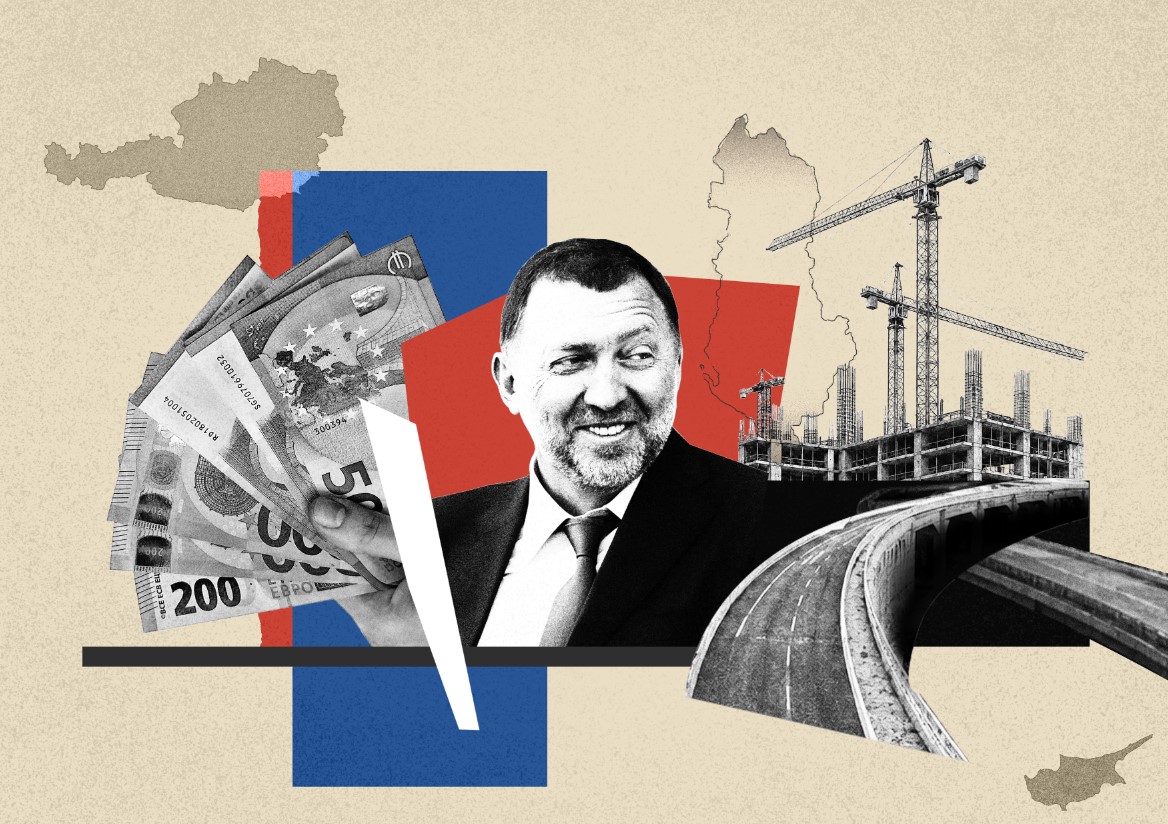
Companies linked to the Austrian giant Strabag received millions of euros from the Albanian state budget at a time when Russian oligarch Oleg Deripaska was a significant shareholder in the group and was under U.S. sanctions. Experts say the case highlights weaknesses in Albanian institutions’ ability to identify the true ownership behind companies receiving public funds.
On July 8, 2026, the General Court of the European Union rejected yet another attempt by Russian oligarch Oleg Deripaska to have the sanctions imposed on him following Russia’s aggression against Ukraine lifted.
The court described Deripaska as an “influential businessman” operating in an economic sector important to the Russian government’s revenues, and dismissed his claims that he had severed ties with his former business interests.
The ruling marked another defeat for the founder of aluminium company Rusal and one of the best-known Russian oligarchs in the West.
But years before European sanctions froze his assets and shareholder rights, Deripaska’s business interests had already reached Albania – not through a Russian company or a business bearing his name, but through one of Europe’s largest construction groups.
Through the company Rasperia Trading Limited, Deripaska controlled a stake of around 28 per cent in Austrian company Strabag SE.
Strabag, meanwhile, had a significant presence in Albania’s construction market, both directly and through its subsidiary Trema Engineering 2, winning contracts for roads, post-earthquake reconstruction and buildings following the 2019 earthquake, as well as other infrastructure projects.
Treasury payment data analysed by BIRN show that, from January 2019 to April 2022 alone, companies linked to Strabag received around 23 million euros from the state budget.
At the time, Deripaska was on the US sanctions list, but had not yet been sanctioned by the European Union.
The case of the Russian oligarch raises questions about the ability of Albanian institutions to identify the economic interests behind companies receiving public funds, as well as highlighting the gap that existed at the time between the US and European sanctions regimes.
Experts told BIRN that checking a company only through its immediate owner is not enough to establish who may ultimately benefit financially at the end of a complex corporate chain.
“Procurement authorities often screen the bidder’s name and perhaps its immediate owner,” said Tom Keatinge, director at the Centre for Finance and Security at RUSI.
“They are much less likely to map the entire ownership chain, voting rights, shareholder agreements and ultimate economic beneficiaries,” he added.
According to Keatinge, a well-known European company can, in such cases, act as a “shield of legitimacy”.
Strabag told BIRN that it has no business relationship with Deripaska and insisted that the Russian oligarch does not directly or indirectly own or control the company or any of the group’s ventures.
“Since the beginning of the war, we have taken a clear stance and implemented decisive measures to distance ourselves from the sanctioned shareholder,” said Birgit Kümmel, Head of International Communications at Strabag SE.
The company also stressed that Strabag is not subject to sanctions that would prevent it from conducting business activities.
The Shield of Legitimacy
For decades, Oleg Deripaska has been one of the most powerful figures in Russian business, building his fortune during the so-called “aluminium wars” and later consolidating it through his ties to the Russian state and President Vladimir Putin.
In 2024, Deripaska publicly described the war in Ukraine as “madness”, although his criticism focused mainly on its costs and economic damage. Nevertheless, Western governments continue to regard him as closely linked to the Kremlin, and he has been under sanctions for years.
In Albania, his economic interests never appeared directly.
The link ran through corporate structures abroad. Through Rasperia Trading Limited, a Cyprus-registered company, Deripaska held around 28 per cent of the shares in Austrian corporation Strabag SE – a stake that was reduced after sanctions were imposed.
Through this ownership chain, the link extended to Strabag’s operations in Albania, including the company Trema Engineering 2 and Strabag’s Tirana branch, which received tens of millions of euros from the state budget for road and infrastructure projects.
Following Russia’s invasion of Ukraine in 2022, Deripaska’s position and that of his interests in Europe weakened significantly. The sanctions froze his assets, including Rasperia’s shares in Strabag, depriving the company of access to the rights stemming from its status as a shareholder.
Deripaska has challenged the measures in courts in various jurisdictions, from Australia to the European Union, but his legal efforts have failed to secure the lifting of the sanctions.
Strabag also confirmed to BIRN that Rasperia’s shares and all rights attached to them were frozen in 2022, in accordance with the European Union’s sanctions regime.
The corporation also said that in December 2024, the Deripaska-linked company changed its shareholders.
“STRABAG SE received the major holdings notification for MKAO “Rasperia Trading Ltd.”, notifying that MKAO Valtoura Holdings Limited controls Rasperia. That would lead to the assumption that Rasperia is not controlled by Oleg Deripaska anymore”, says the answer.
However, the changes in the ownership structure have been viewed with suspicion by authorities in the European Union and the United States, while Rasperia Trading Ltd’s shares in Strabag SE remain frozen and subject to sanctions.
The case highlights the difficulty institutions face in identifying the economic interests of sanctioned individuals when these are concealed behind multiple layers of corporate ownership and companies registered in different jurisdictions.
According to Zef Preci, executive director of the Albanian Center for Economic Research, in today’s economy, “formal ownership, meaning what is recorded in official documents, is often merely a façade.”
He points out that actual control, economic benefit and influence over decision-making “can pass through chains of companies, intermediary shareholders, hidden agreements and offshore jurisdictions.”
For Albania, according to Preci, this is not an isolated problem. He argues that some concessions awarded over the past decade have been built around similar ownership structures, which he says pose a risk to the integrity of the state.
“If public funds are used by companies that, directly or indirectly, generate benefits for sanctioned individuals such as Deripaska, then the problem is no longer technical; it is a matter of state integrity, economic security and trust in public procurement,” he said.
The Four-Year Gap
The United States sanctioned Oleg Deripaska in 2018, adding him to its list of sanctioned individuals over a range of allegations related to the activities of the Russian government.
The European Union took a different approach.
Brussels sanctioned the Russian oligarch four years later, in April 2022, following Russia’s aggression against Ukraine.
The four-year gap between the U.S. and European sanctions also had consequences in Albania.
Although Deripaska had been under U.S. sanctions since 2018, Albanian companies linked through the ownership chain to Strabag continued to receive public contracts and payments from the state budget.
Data from the Albanian Institute of Science, through its Spending Data platform, which compiles State Treasury expenditures, show that from January 2019 to April 2022, when the European Union imposed its sanctions, companies in which Deripaska was an indirect shareholder received approximately €23 million, based on the exchange rate at the time.
The payments were mainly linked to infrastructure projects financed by the Albanian Development Fund, as well as reconstruction tenders following the November 2019 earthquake.
Agon Maliqi, a nonresident researcher at the Atlantic Council in Washington, D.C., sees this as the consequence of a legal and political gap that was not unique to Albania.
“At the time, both in Europe and in Albania, despite the U.S. sanctions, there was no legal basis for preventing an Austrian company from operating,” Maliqi says.
He adds that “Albania, in this case as in many others, found itself caught in a kind of sandwich between U.S. and European (in this case, Austrian) pressure.”
Tom Keatinge, a sanctions expert at the Royal United Services Institute (RUSI), warns that such gaps create opportunities for economic interests to be restructured before sanctions are harmonized.
According to him, these gaps are critical “because they create a window in which assets can be moved, ownership can be restructured, and contracts or financing arrangements can be secured.”
However, Keatinge points out that Albania could not be blamed for the situation, nor could it have acted solely on the basis of U.S. sanctions.
The problem, he says, arises when different sanctions regimes create what he calls a “weakest-link problem,” whereby “a transaction rejected in one jurisdiction can migrate to another where controls are less developed.”
Identifying Ultimate Beneficial Owners as an Illusion
Beyond Europe’s delay in imposing sanctions, experts also identify weaknesses in Albania’s mechanisms for monitoring corporate ownership.
Albania has a beneficial ownership registry, but Zef Preci describes it as a “self-declaration archive” rather than a genuine control mechanism.
According to him, when a discrepancy or ownership issue is identified, it should not remain “merely an administrative note.” Institutions, he argues, should have the power to block a tender, suspend the company extract, and “refer the matter for financial and criminal investigation.”
“Transparency cannot be optional; a contract should not be signed without clearly identifying the ultimate beneficial owner,” Preci says.
He also points to changes in company ownership after public contracts have been signed as a problem.
“Ownership changes, shares are sold, control shifts, and sanctioned individuals may appear later in the chain of beneficiaries,” he emphasizes.
According to Preci, laws and registries also have limited effect if the administration lacks the capacity or willingness to scrutinize complex ownership structures.
He notes that in such cases there is often “an inability to look beyond the first document,” while also denouncing political interference, which he says “exerts implicit pressure on institutions.”
“All it takes is an unofficial meeting at government offices, a visit to places where the prime minister neither negotiates nor signs anything in the public interest, or even just a photo with him, and the public administration falls into line to blindly serve ‘businessmen’ of this kind,” Preci says, claiming that in such cases institutional obstacles “disappear.”
Hybrid Warfare Through Enablers
The benefits enjoyed by companies linked to Oleg Deripaska in Albania were not limited to infrastructure contracts.
In 2017, “Trema Engineering 2” acquired a 33% stake in the concession company “Shushica Hydropower Sh.p.k.,” a concession project that was later cancelled amid objections from environmental activists and the government’s decision to place the Vjosa River and its tributaries under protection.
For Agon Maliqi, direct investments in the formal economy are only a “peripheral” element of the ways in which Russia can exert influence.
“Russia prefers corrupt ties that would make these elites vulnerable to blackmail and susceptible to influence, enabling them to serve Russian interests,” Maliqi says.
However, according to him, Albanian elites have had other significant sources of financing that have fueled corruption, without necessarily requiring Russian capital.
Ironically, he says it is possible that “links to organized crime and international trafficking have weakened the temptation toward Russian capital.”
But organized crime can also be a vulnerability that can be exploited for foreign influence.
“My personal suspicion is that Russia may have targeted Albania’s weakest link from a security perspective – one with significant informal power – and that is organized crime and its political connections,” Maliqi says.
One of the cases linking Albania to Deripaska’s circle is that of former senior FBI official Charles McGonigal.
McGonigal pleaded guilty in the United States in a case related to his work for Deripaska after leaving the FBI. At the same time, his activities in Albania and his contacts with individuals linked to the Albanian government became part of a separate criminal case in the United States.
The McGonigal case illustrates the role of what Keatinge calls “Enablers” – facilitators who help build and operate sophisticated financial and corporate structures.
“Enablers are often the operating system of sanctions evasion,” says the RUSI expert.
” Lawyers, accountants, corporate service providers, consultants, bankers and other intermediaries can provide both technical capability and a veneer of legitimacy”, he adds.
The case of interests linked to Deripaska in Albania raises questions about the ability of bureaucratic safeguards and formal registries to protect public funds from the interests of sanctioned individuals.
When such interests pass through companies that are legally registered and active in the European Union, experts argue that institutions cannot rely solely on formal documentation, but must verify ownership and the ultimate economic beneficiaries.
Beyond procedures, Maliqi sees the issue as being tied to the immunity of Albanian institutions from corruption, which he identifies as one of the system’s main vulnerabilities.
“Corruption is, at its core, also a national security vulnerability,” he concluded.
The MKAO is a transliteration of the Russian abbreviation for “International Joint-Stock
|| By Vladimir Karaj – BIRN