




The prestigious financial daily Financial Times raises serious doubts that behind the Port of Durrës project, Durrës Yachts & Marina, lies a broader plan by the United Arab Emirates to project their influence beyond their own borders.
In an article dedicated to the projects of Mohamed Alabbar, Financial Times emphasizes that the port was awarded without a tender and that it has been strongly criticized by the opposition.
“Meanwhile, activists in Serbia have criticised the award of the major Belgrade waterfront project to Eagle Hills, claiming the process was not transparent. The port project in Albania’s Durrës, which also had no public tender and was initially linked to Emaar, has been criticised by opposition lawmakers. Other critics argue that Emaar and Eagle Hills act as tools of the UAE’s soft power, spreading the country’s influence abroad,” the article states.
Financial Times notes that Alabbar has responded to accusations of taking over the port without competition by claiming that Albania had not been able to find other investors for the project. However, at least under the Stabilisation and Association Agreement, the Albanian government should have organised an international competitive procedure.
“But Alabbar insisted that independent auditors had drafted the Serbian and Albanian contracts, while arguing that Albania had not been able to find other investors willing to take on the port redevelopment. And he argued that singling out the UAE for using commercial influence abroad was unfair, citing Donald Trump’s push for a US company to take control of the Panama Canal.”
Zoom.al has previously raised suspicions in several articles that behind the Port of Durrës stands Sheikh Bin Salman Zayed, based on information from reliable diplomatic sources.
There are also suspicions that the construction of the Tourist Port will serve as a money-laundering vehicle for powerful international drug-trafficking groups, particularly those who, in order to escape Albanian justice, have settled in Dubai — the same place where Eagle Hills and Alabbar are headquartered.
GazetaAlbania.com is publishing in full the Financial Times article.
The second act of Burj Khalifa’s builder Mohamed Alabbar: Beyond Dubai
The expansion abroad of real estate tycoon Mohamed Alabbar
While visiting the luxurious Egyptian beach resort that has taken more than a decade to build, the Gulf’s most prolific billionaire developer often has to stop for curious guests asking for selfies.
The rising profile of Mohamed Alabbar outside his native United Arab Emirates signals a new phase for the 68-year-old, who stands behind both the world’s largest shopping mall and its tallest skyscraper — Dubai Mall and Burj Khalifa.
Credited with a key role in building modern Dubai, the founder of state-backed developer Emaar has embarked on a fresh wave of international expansion. Although his first attempts to go abroad in the early 2000s ran into difficulties, Alabbar’s empire of influence now stretches from the vast Marassi development on Egypt’s Mediterranean coast to Serbia and even Madagascar, mirroring the UAE’s reach beyond its borders.
“We are a small country,” Alabbar told the Financial Times. But by investing in countries often overlooked by Western investors, he added, “can we build a billion-person economy?”
For his second act, the property magnate is leading another development company: Eagle Hills, a private investment fund backed by wealthy Abu Dhabi families.
At the same time, he and Saudi Arabia’s sovereign wealth fund own a majority stake in the region’s largest fast-food group, Americana, and in 2016 Alabbar launched the e-commerce company Noon to compete with Amazon in the Middle East. Alabbar chairs the UAE digital lender Zand Bank, and oversees Emaar — which is listed and also runs shopping malls and hotels — as its group managing director.
Although seen as a maverick, few members of the region’s royal families enjoy Alabbar’s level of access to power. A lieutenant of Dubai’s ruler Sheikh Mohammed bin Rashid al-Maktoum, he has also forged ties with the Abu Dhabi royal family and regularly accompanies the UAE president, Sheikh Mohammed bin Zayed al-Nahyan, on foreign visits.
Giorgio Armani’s deputy chief executive, Giuseppe Marsocci — with whom Alabbar has worked on branded residences and hotels — described him as “culturally open-minded” with “very detailed attention” to projects. “He doesn’t accept the first idea,” Marsocci added. “He wants to go deeper.”
Alabbar and Dubai have both been buoyed by a property market boom fuelled by a surge in population, as foreigners flock to the safe, low-tax UAE.
But his beginnings were modest: the son of a dhow captain whose boat sank twice, and one of 13 children, Alabbar grew up in a two-room state-provided house that he shared with two cows. He despises the “billionaire” label, calling it “inappropriate” for the UAE’s reserved culture. “I come from social housing,” he said. “That’s where I belong.”
After graduating in 1981 from Seattle University on a UAE government scholarship, Alabbar worked at the central bank before becoming director of a Dubai investment company in Singapore, whose holdings in shopping centres exposed him to the retail market in the Asian financial hub. He returned to Dubai in the early 1990s to set up a new government department dedicated to economic development and oversaw several other state-owned companies.
As development accelerated after Sheikh Mohammed bin Rashid al-Maktoum became Dubai’s crown prince and de facto ruler in 1995, Alabbar began raising funds for a real estate company. With the venture blessed by Sheikh Mohammed in 1997, Emaar was granted prime land, which was later swapped for a stake in the company that the Dubai government still holds.
Emaar and Alabbar were shaken by Dubai’s first spectacular property crash, triggered by the global financial crisis, as he lost millions in US real estate ventures and mining projects in Africa. And Alabbar has his critics: not everyone in the Dubai market approves of his fast-talking style and imposing approach.
His management style is that of a “megalomaniac”, according to one executive who has worked with him.
But the businessman has maintained a reputation for rapid project delivery, a highly valuable currency in an oil-rich region with big ambitions.
“His implementation record was much stronger than his competitors,” said Jim Krane, author of Dubai: The Story of the World’s Fastest City, and he “maintained credibility after the crash”.
Alabbar said: “Over 20 years of experience, I made some mistakes. Maybe now I’m a better manager.”
He has now set his sights beyond the UAE. Emaar has operations in countries such as Egypt and India, while Eagle Hills is working on multi-billion-dollar waterfront developments in Belgrade and Riga, as well as a coastal resort and marina on Albania’s Adriatic shore. It also owns hotels in Croatia, Munich and Muscat, and in September announced a planned $5.5 billion investment in Georgia for two developments, including in the capital Tbilisi.
Developers’ appetite for new projects is ferocious.
“I want to build my own Bali,” Alabbar said enthusiastically about a resort he is planning in Madagascar. In Montenegro, he is planning “something really huge”, while he said land had been allocated to Eagle Hills in North Macedonia’s capital, Skopje, and that he was also exploring a hill town in the country for a summer resort.
But Alabbar’s global expansion has also attracted criticism. The exclusive 7-kilometre shoreline at Marassi, mocked by some as a Dubai “copy-paste”, is part of what some Egyptians call “the wicked coast” because prices are out of reach for most of the public. Similar accusations of creating an elite enclave have followed the Serbian development.
Alabbar stressed that he wanted to undertake projects that were welcomed by local communities. While he acknowledged that developments such as Marassi and Belgrade Waterfront were designed for the wealthy, he argued that they created jobs, increased tax revenues and gave rich people somewhere to spend their money domestically.
“People live in luxury in Singapore, Beijing, Beverly Hills, Mayfair,” he said. “Why can’t we have, in Egypt, a Mayfair too? Give us a share of the rich people here.”
Meanwhile, activists in Serbia have criticised the award of the major Belgrade waterfront project to Eagle Hills, claiming the process was not transparent. The port project in Albania’s Durrës, which also had no public tender and was initially linked to Emaar, has been criticised by opposition lawmakers. Other critics argue that Emaar and Eagle Hills act as instruments of the UAE’s soft power, spreading the country’s influence abroad.
But Alabbar insisted that independent auditors had drafted the Serbian and Albanian contracts, while arguing that Albania had not been able to find other investors willing to take on the redevelopment of the port. And he argued that singling out the UAE for using commercial influence abroad was unfair, citing Donald Trump’s push for a US company to take control of the Panama Canal.
UAE businesses “are not instructed by the government to go and buy a port from the Chinese”, Alabbar insisted. “We never behave like that.”
While he linked the willingness of Emaar and Eagle Hills to do business in often underinvested markets to the UAE’s own experience of rapid growth, he said they exist to make a profit.
“Forty years ago… we wanted someone to come and do development in our country,” he said, and Emiratis now felt “excited” that they could tell the people of Serbia “we will help you”. “But please, we need to make some money.”
Since unification in 1971, following the discovery of oil in the late 1950s, the UAE has risen from relative poverty at breakneck speed. The country “is only 50 years old”, Alabbar said. “We are young, we must work day and night to make it.”
Long-time business associate Ramesh Prabhakar, vice-chair and managing partner of the Dubai-based luxury group Rivoli, said Alabbar was “impatient”. But “in an emerging market… there is no tomorrow. You have to do it today.”
Given his reputation as a demanding boss, some candidates invited to job interviews at Emaar never showed up, Alabbar said. He described his management style as loyal and generous, but admitted he could be harsh. When executives made mistakes, he said: “I don’t give them two chances.”
He “won’t tolerate fools”, Prabhakar said. “There is only one captain of the ship.”
Alabbar’s expansionism — creating an atmosphere of constant motion — clashes with a micromanaging obsession with cutting costs. Recently, he reduced the tea selection in Emaar’s office from three types to one, and in a bid to improve productivity he banned group meetings in September — though staff could seek permission for meetings from the group CEO.
“When things are going well, I squeeze efficiency reports to the maximum… in case something happens, we are in shape,” he said, adding: “I am a paranoid guy.” Alabbar attributed this impulse to his experience in Singapore and his work with executives from India’s notoriously cost-conscious market.
Although Alabbar acknowledges he is profit-oriented, Prabhakar said the property magnate had in recent years developed “a more human element” and now viewed business from the perspective of “a greater good”. In his overseas ventures, Prabhakar said, Alabbar wanted to “energise communities and bring some islands of excellence.”
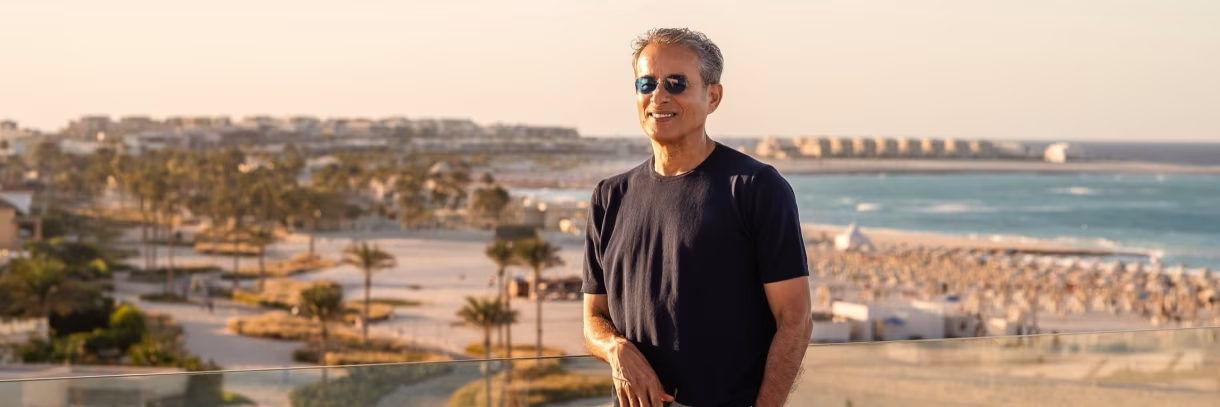
Standing atop one of Marassi’s many luxury hotels, overlooking the turquoise Mediterranean and a villa where Egypt’s president sometimes stays, Alabbar scanned the vast property for potential improvements. He said he had recently changed all the flowers across the resort, deciding the previous ones were not colourful enough. He had arrived by private jet from Angola, where a UAE delegation had signed business deals.
Yet despite his evident restlessness, Alabbar said he was enjoying a peak in his career:
“I open my iPad and it’s about Madagascar… it’s about Noon, autonomous vehicles. And then it’s about Montenegro. What a lucky man I am.” https://www.ft.com/content/25c68ef2-196d-44ee-9cbb-e2e16eb43af9